
Background:
A leading cement manufacturer contacted Hindon regarding a safety and operational challenge with the cooler fans at their Midwestern US plant. Cement factories rely on these large industrial fans to rapidly cool red-hot rock as it exits the kiln to ensure it hardens into high-quality cement. As these fans blow cool air over the hot material, the air heats up and is recycled back into the furnace to increase fuel efficiency.
The customer’s maintenance team faced a persistent issue where backdraft pressure caused the large industrial fans to spin in reverse when powered down. To stop this reverse spin, operators were forced to manually stop the rotation. The existing maintenance lockout procedure was unreliable and posed a safety hazard, relying on improvised techniques such as wedging a wooden board into the fan blades to inhibit rotation. The customer required a modern, reliable mechanical solution to hold the fans stationary during maintenance and ensure workers’ safety.
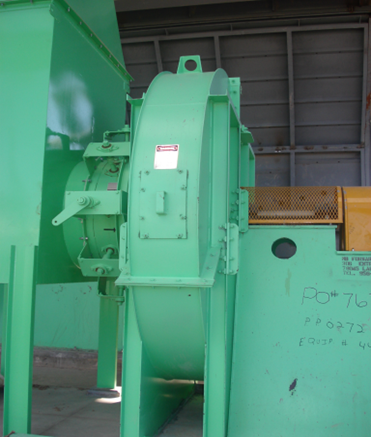
This application also required the replacement of the existing coupling due to dimensional limitations between the motor and fan shaft. Hindon provided a coupling with integral brake drum.
Application Challenges:
- “Wind-milling” caused by backdraft prevented operators from safely securing the fan when not in use
- Lack of reliable compressed air or hydraulic infrastructure meant a strictly mechanical braking solution was preferred
- The solution needed to fit into the existing 283mm spacing between the motor and fan shafts while minimizing retrofitting costs
Solution:
Following an in-depth consultation to fully clarify the customer’s operational needs and priorities, Hindon engineered a custom manually released braking system that acted as a true mechanical lockout. The solution centered on replacing the existing coupling with a pin coupling featuring an integral 315mm brake drum for use with a spring-applied, manually released drum brake, capable of adjustable braking torque that exceeded the full load motor torque including safety factor.
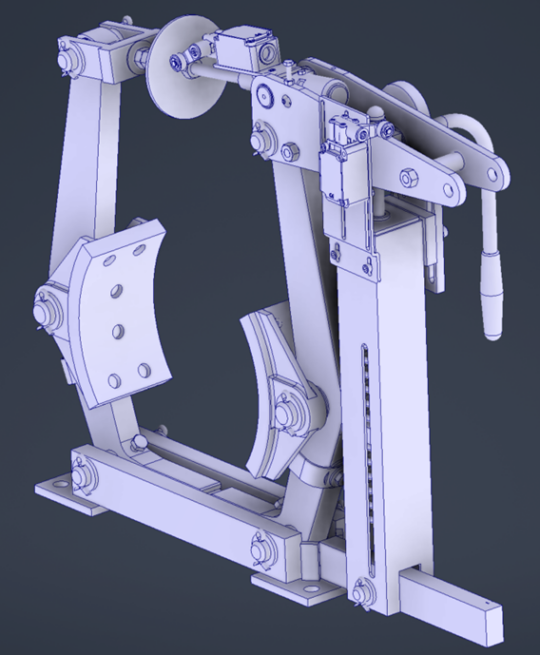
The spring-applied, manually-released drum brake specified by Hindon including the Emergency Manual Release lever equipped with a limit switch for brake status indication.
This fail-safe design was the optimal choice for this application for several reasons.
By utilizing a spring mechanism to apply the brake, the brake remains engaged regardless of power availability, effectively locking the fan until it is manually released by an operator.
Another benefit of using a spring applied brake for this application is that the customer ensures the exact braking torque provided by the brake is known and quantifiable, which is not the case for many other manually applied braking systems.
Lastly, the Emergency Manual Release Lever, used by an operator to release the brake, was equipped with a limit switch, allowing the plant to tie the brake’s status into their plant control system to ensure the motor could not be started unless the brake is fully released.
Furthermore, unlike more complex braking systems, this purely mechanical design utilizes no hoses, seals, or valves, significantly reducing long-term maintenance requirements.
To ensure a seamless retrofit, Hindon specified a space-efficient pin coupling with brake drum to replace the existing coupling.
This rugged, maintenance-friendly manual braking system solved the fans’ wind-milling issue and ensured the safety of operators and maintenance personnel.