
Background:
Maintenance managers for a leading provider of midstream energy services, including natural gas, crude oil, petrochemicals, and refined products, approached Hindon to design and supply a robust safety solution for Induced Draft (ID) fans for Hot Oil Heaters operating in their fractionation units. In fractionation units, ID fans are used to evacuate flue gases and maintain a slight vacuum (negative pressure) inside the heater. This is a necessary safety feature for personnel working nearby, ensuring that if there are any leaks in the heater walls or inspection ports, air is drawn in, preventing hot flame and lethal gases from blowing out. The ID fans interact with a VFD to maintain flame stability and maximize fuel efficiency by controlling the combustion airflow.

Hindon’s customer, a leading oil and gas producer, was in need of an industrial braking system for several of their industrial fans.
Routine maintenance on these large industrial fans requires personnel to work in close proximity to rotating machinery. To ensure the safety of maintenance personnel, the customer required a reliable lockout method to immobilize the fans during maintenance. The challenge was to implement a manual industrial braking system that could easily integrate with existing equipment while providing enough holding force to completely secure and lock out the fan rotation against wind or an inadvertent motor startup.
Application Challenges:
- The customer needed the braking system to mount directly to the existing fan-side rigid hubs without costly machinery retrofitting
- The safety lockout mechanism needed to operate reliably without reliance on facility power or pneumatic/hydraulic systems
- The braking system needed to be capable of enough braking torque to hold the fan if the motor were fully energized
Solution:
Hindon supplied a specialized manual braking solution tailored to the application’s load requirements, existing equipment, and spatial constraints. The project utilized a two-tier approach: (10) manually actuated brakes on 400mm discs for smaller fans, and (4) manually actuated brakes on 610mm discs for larger fans.
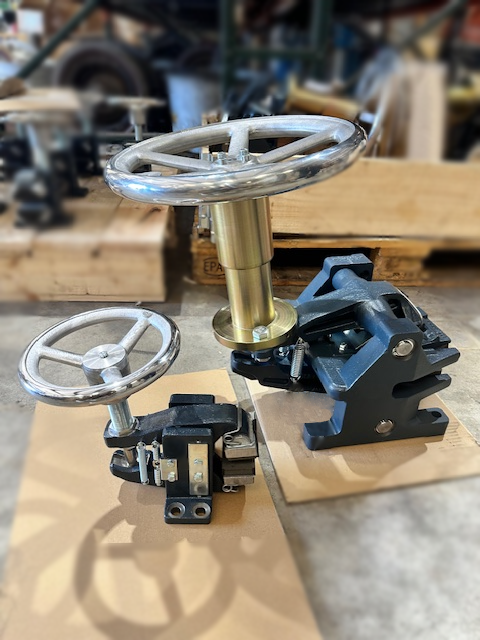
The smaller brakes (pictured left) are capable of 450 Nm of braking torque on a 400 mm diameter disc. The larger brakes (pictured right) are capable of 7,000 Nm of braking torque on a 610 mm diameter disc.
A key factor in selecting these manual brakes was their ability to operate independently of external power sources while applying a precise, consistent holding torque. This style of brake requires no electricity, hydraulics, or plant air to operate, making them immune to power outages or compressor failures. The manually-applied, manually released design ensures that once the brake is engaged, it is capable of securing its load indefinitely without the pressure loss associated with fluid-based systems.
To meet the application’s unique retrofit constraints, Hindon designed the brake discs with custom bolt circles and locating diameters. This allowed the new discs to bolt directly onto the existing coupling hubs, creating a seamless “bolt-on” solution that avoided costly equipment redesigns and/or on-site machining.
Importantly, Hindon engineered the system with a critical safety factor: the torque capacity of the brakes was specified to exceed the full load torque of the drive motors. This robust brake sizing provides a verifiable lockout capability, ensuring the safety of plant personnel during maintenance operations.
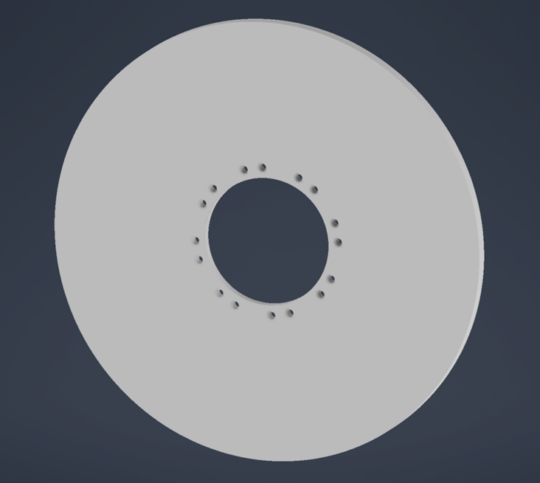
The brake discs supplied by Hindon were custom designed and manufactured based on the customer’s existing couplings. The customer did not have drawings for the existing couplings, so the couplings were sent to Hindon so that Hindon could design the discs with the appropriate custom bolt circles.