
Background:
As part of an upgrade project, engineers for the Gateway Arch Tram System in Saint Louis, MO approached Hindon to design and supply an upgraded custom tram braking system.
The Gateway Arch Tram System transports visitors from an underground visitors’ center to a viewing area located 630 feet above ground at the top of the arch. The method of conveyance used by the tram is a one-of-a-kind drive system, combining mechanical elements from elevator and Ferris-wheel design into a system specially built for the unique constraints inside the walls of the arch. The tram systems are powered by a hoist motor located at the top of each half of the arch.
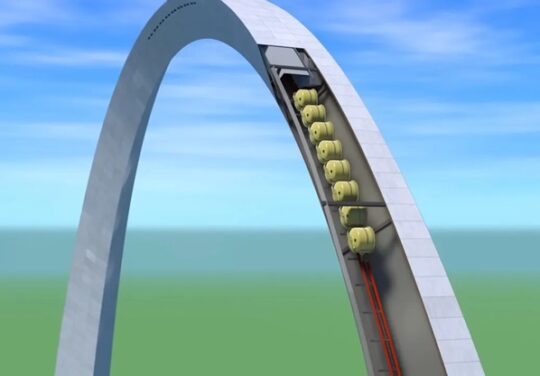
Both halves of the arch have their own tram system consisting of 8 cars, each transporting up to 40 people up or down the arch at once at approximately 4 miles per hour. Approximately 6400 visitors go to the top of the arch per day (about 80 trips daily).
The tram system relies on a Variable Frequency Drive (VFD) motor brake in combination with onboard safety brakes to manage deceleration. The safety brakes are integrated into the four‑wheel chassis of the last car on each tram, employing an eccentric dog mechanism that locks onto the track whenever the transporter’s downward speed exceeds the rated limit by 15%. Also, a hydraulic buffer installed on counterweights is connected to the final capsule and ensures controlled deceleration until the transporter comes to a complete stop.
While effective for slowing the trams under normal operation, the original braking system was not specifically designed for failsafe operation required in an emergency. To address this limitation, the customer required the installation of spring‑applied, electrohydraulic thruster‑released brakes as a critical safety redundancy and for holding/emergency use. Precise control over the speed of brake engagement and release was a key design requirement, ensuring that passengers experience smooth deceleration and maximum safety—even during an emergency braking actuation. Additionally, the unique space constraints presented by this application meant that the brakes not only needed to fit within a challenging dimensional envelope, but they also needed to be able to be easily maintained considering the same dimensional constraints and accessibility limitations.
Application Challenges:
- Limited space and mounting orientation required a nonstandard engineered solution
- Set and release time adjustable between ¼ and ½ seconds
- Priority on minimizing and simplifying maintenance requirements as much as possible due to accessibility limitations
Solution:
Hindon supplied specialized hoist braking systems tailored to the application’s unique requirements featuring a spring-applied, electrohydraulic thruster released drum brake engineered for an inverted, 18.1-degree angled, ceiling-mounted orientation.
A key design feature of these industrial brakes included the use of a special brake release thruster allowing for terminal box reorientation, simplifying maintenance access. This type of thruster brake was chosen to provide failsafe braking, offering the precision and effectiveness of hydraulic actuation without the need for dedicated hydraulic lines or a discrete Hydraulic Power Unit (HPU), as the compact hydraulic system is contained within the electrically powered thruster integrated directly into the brake design. The brake release thrusters were also equipped with adjustable lifting and lowering valves allowing the operator to fine tune the braking action as needed.
To improve operational practicality, the brakes were equipped with easily accessible and externally adjustable torque spring assemblies, manual release levers, brake centering linkages, and automatic wear compensation, reducing the need for routine brake pad maintenance except following an emergency actuation. The brakes also utilized proximity switches to allow continuous indication of the brake status and limit switches to track the degree of lining wear. Both types of switches provided by Hindon are easily programmable for seamless integration into an existing PLC.
In addition to the custom thruster brake assemblies, Hindon designed and supplied new pin couplings featuring an integrated brake drum, transmitting power and torque between the existing motors and gearboxes for a low-profile engineered solution. The couplings were specifically designed to accommodate axial, radial, and angular misalignment between the two shafts, facilitating installation.
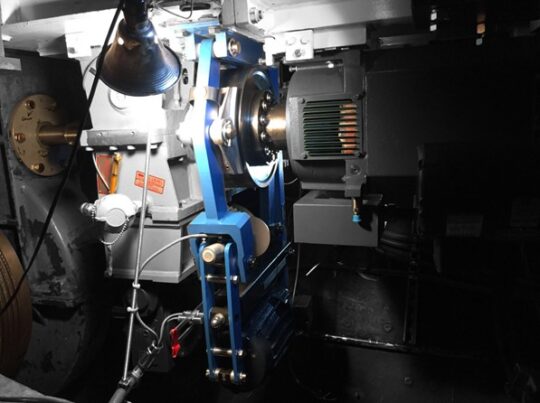
The brake’s unique features, including its compact design and the challenge of the inverted, 18.1-degree mounting irregularity with special thruster configuration, were key considerations in this project.
Hindon’s industrial braking systems gave the tram system, on one of the United States’ most iconic landmarks, an additional, modernized layer of braking safety in the event of a failure. This necessary addition allowed the famous tram system designed by Dick Bowers to adapt to modern safety standards such as ASTM, AISI, ANSI, IEEE, NEMA, and ASME elevator safety.